CRM Automation · Sales Operations · API Integration · AI
TeacherTee Outbound Sales System
An end-to-end outbound sales operating system connecting prospect data, enrichment, CRM synchronisation, engagement-led mobile enrichment, SDR workflows and AI-generated call documentation.
- Client
- TeacherTee
- Role
- Technical Implementation & Sales Operations
- Initial launch
- July 2026
- Current version
- V3 — September 2026
- Status
- Production deployment
1,904
Leads processed
658
Mobile numbers enriched
19
Discovery meetings booked
317–476 hrs
Estimated manual preparation avoided
Based on 1,904 leads × 10–15 min pre-implementation estimate; not formally time-tracked.
At a glance
The operating problem, objective and implementation scope
A compact view of what the system needed to change and who owned the work.
Business problem
Manual preparation capped useful volume
Researching companies, finding the right stakeholder, enriching that person and updating the CRM was estimated to require 10–15 minutes per lead.
Objective
Keep a small team focused on selling
Maintain a regular supply of sales-ready leads without adding sales administration headcount.
Sean's ownership
End-to-end technical delivery
- Defined requirements with Luke and selected the software
- Made budget decisions jointly with Luke
- Designed, configured, implemented and tested the system
- Trained the SDR, monitored live performance and iterated from call feedback
Stack
Connected operational tooling
- Airtable
- Make.com
- Apollo
- Leadconnector (GoHighLevel)
- Claude API
- REST APIs and webhooks
The challenge
Useful outbound volume was incompatible with manual preparation
At an estimated 10–15 minutes of research, stakeholder identification, enrichment and CRM administration per lead, meaningful outbound volume would have been impractical for a small team.
The SDR should focus on
- Call sales-ready contacts
- Hold genuine conversations
- Send bespoke follow-up information where requested
The system should remove
- Research every lead
- Manually enrich contact data
- Create or update routine CRM records
- Move opportunities through routine stages
- Remember repeated No Answer attempts
- Write detailed CRM notes after qualifying calls
Commercial constraint
Apollo credits were limited, so paid mobile enrichment could not be run indiscriminately against every record. The system needed to decide where that spend was most useful.
System architecture
One connected outbound operating system
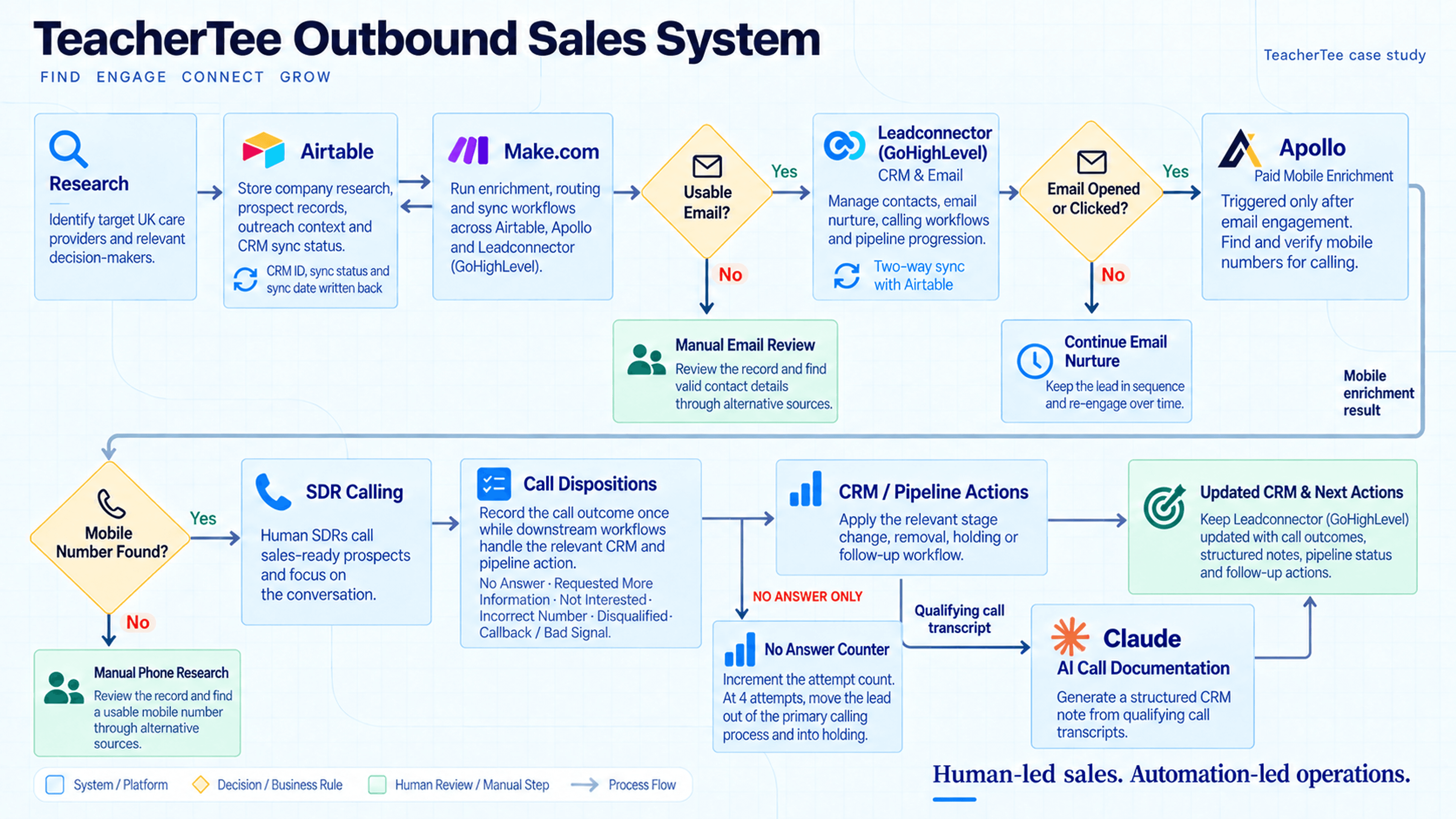
The design links prospect research, source data, enrichment, CRM activity, engagement signals, SDR calling and AI-assisted documentation into one traceable operating flow.
How the system works
Five connected stages, each solving a specific operating problem
The implementation is presented as an operating sequence rather than a list of software modules. Evidence sits beside the decision or workflow it supports.
Stage A
Research & source data
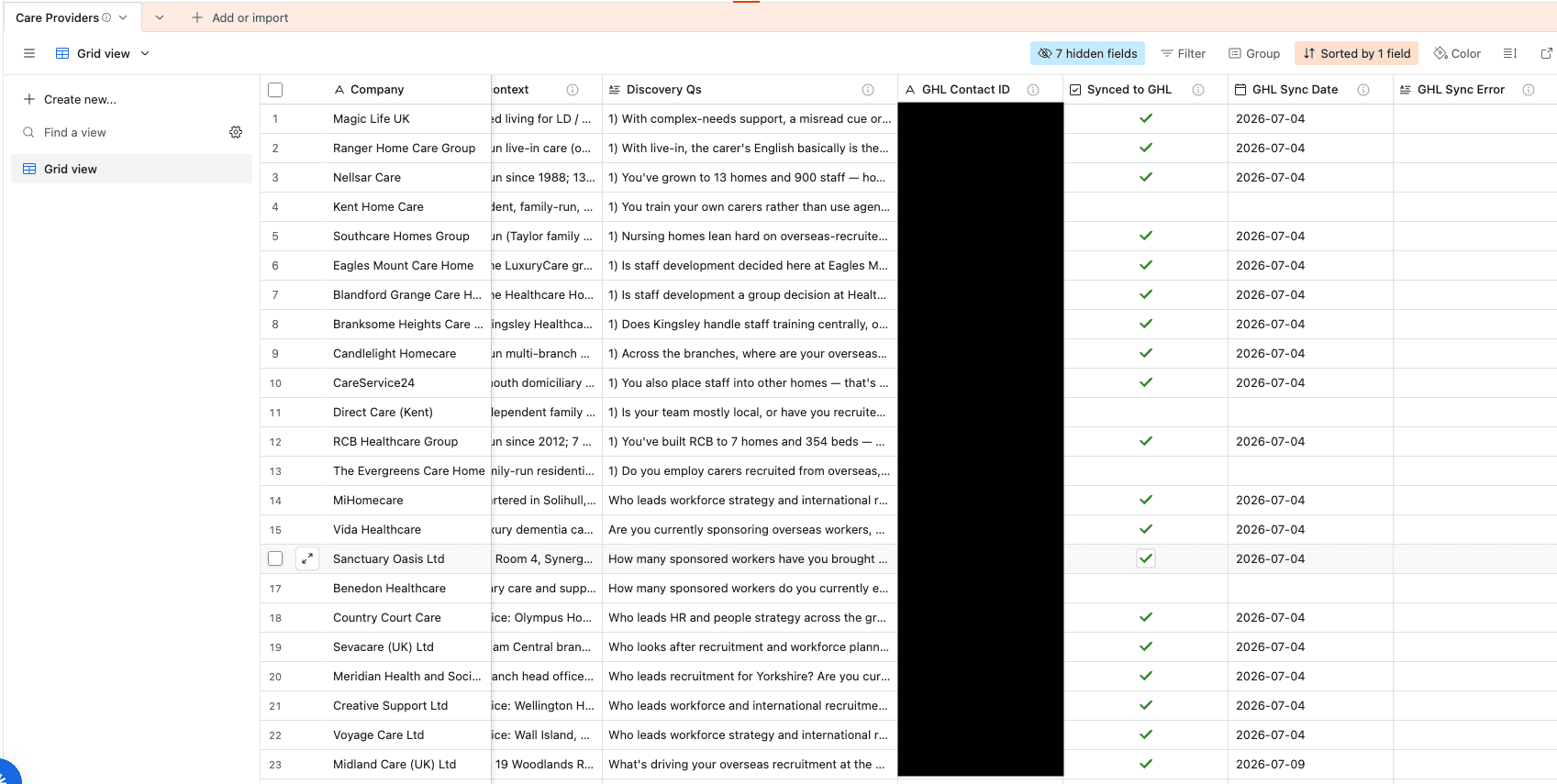
Prospect and company research is structured in Airtable so the downstream workflows begin with consistent source data rather than ad hoc lists.
Why it matters
A reliable source layer makes the rest of the system easier to trace, troubleshoot and improve.
- Company and stakeholder context starts in one source dataset
- Records carry the fields required for enrichment and CRM creation
- Operational status remains visible as each record moves through the system
Stage B
Primary email enrichment & CRM synchronisation
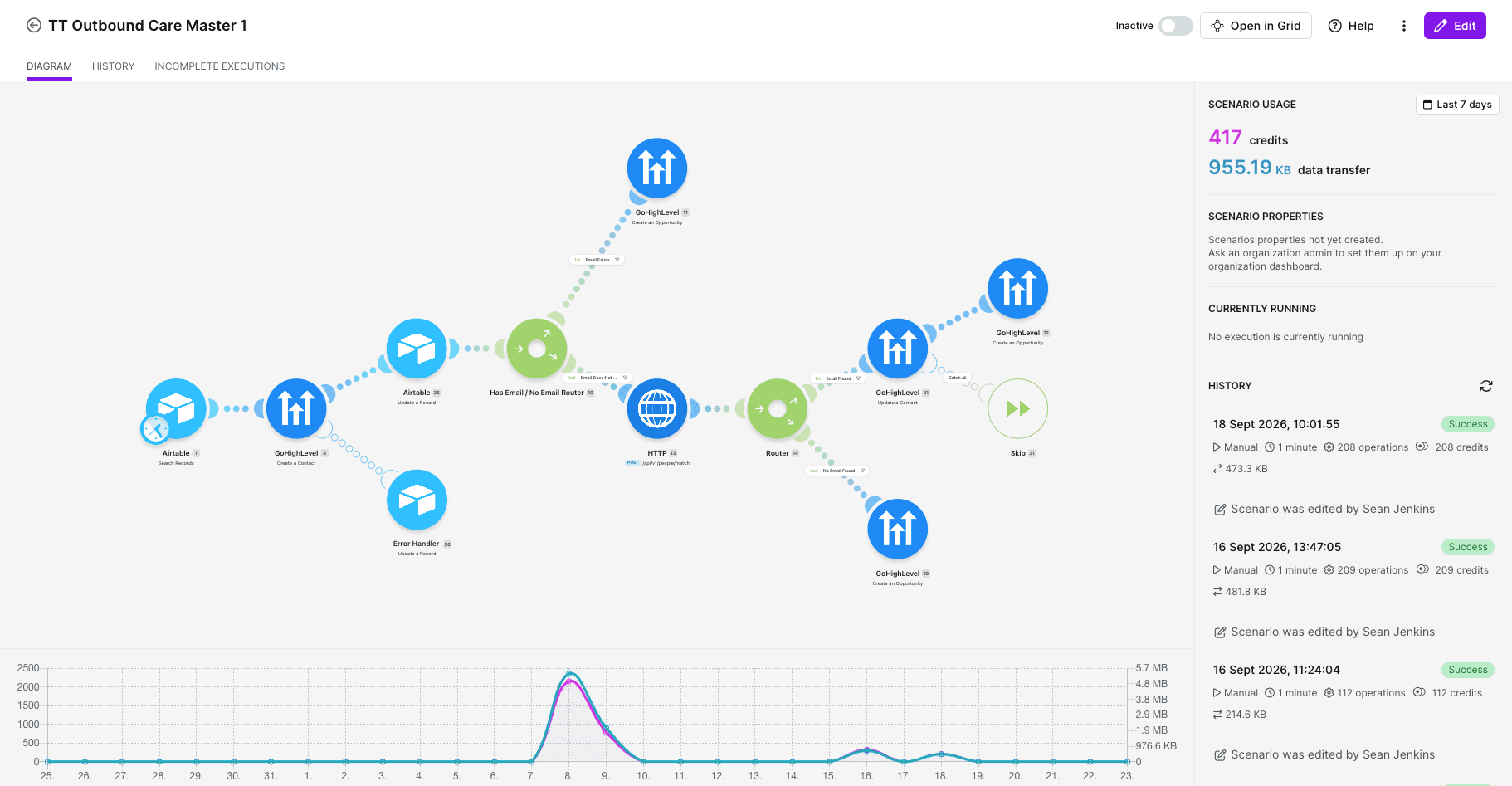
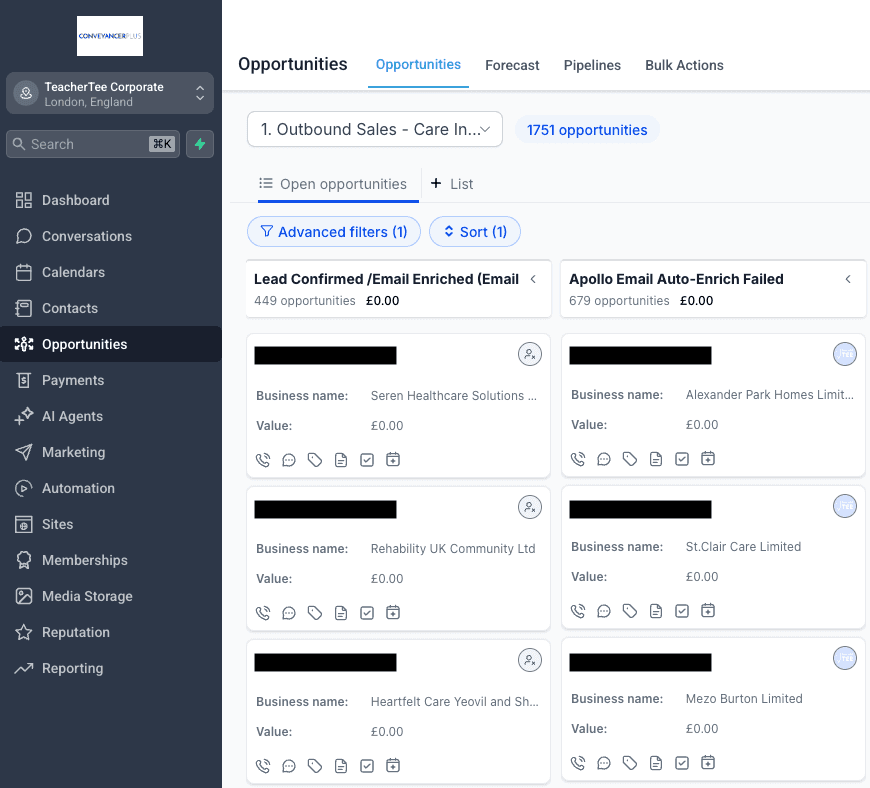
Make.com coordinates Airtable, Apollo and Leadconnector (GoHighLevel) to create or update CRM contacts, attempt primary email enrichment and route success or failure states.
Why it matters
Persistent CRM identifiers and explicit sync states reduce duplicate processing and provide a practical audit trail across systems.
- The batch ran periodically to control enrichment costs
- Duplicate-contact errors route through deliberate handling
- Leadconnector (GoHighLevel) contact IDs, sync dates and status are written back to Airtable
- Successful and failed email enrichment move into separate CRM pipeline states
Stage C
Engagement-led mobile enrichment
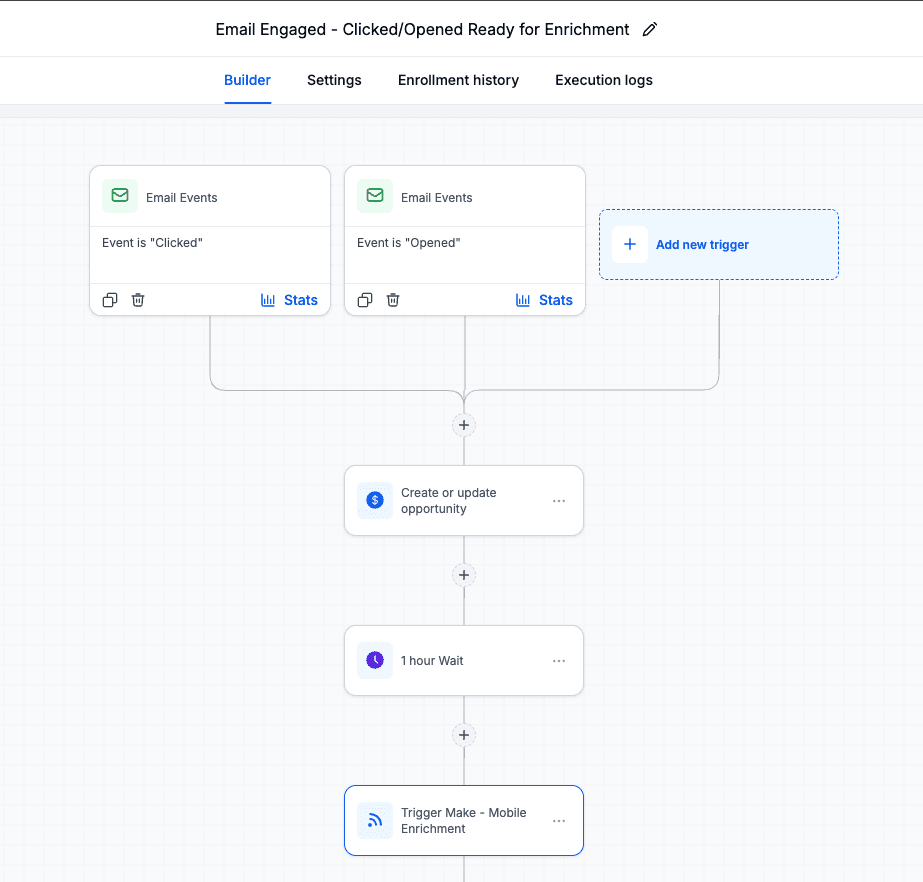
A usable work email creates the first route into the CRM. Mobile enrichment is triggered later when a contact opens or clicks a campaign email.
Why it matters
The design focuses limited Apollo credit spend on contacts showing an engagement signal without claiming that engagement proves phone availability.
- Opens and clicks trigger the next enrichment stage
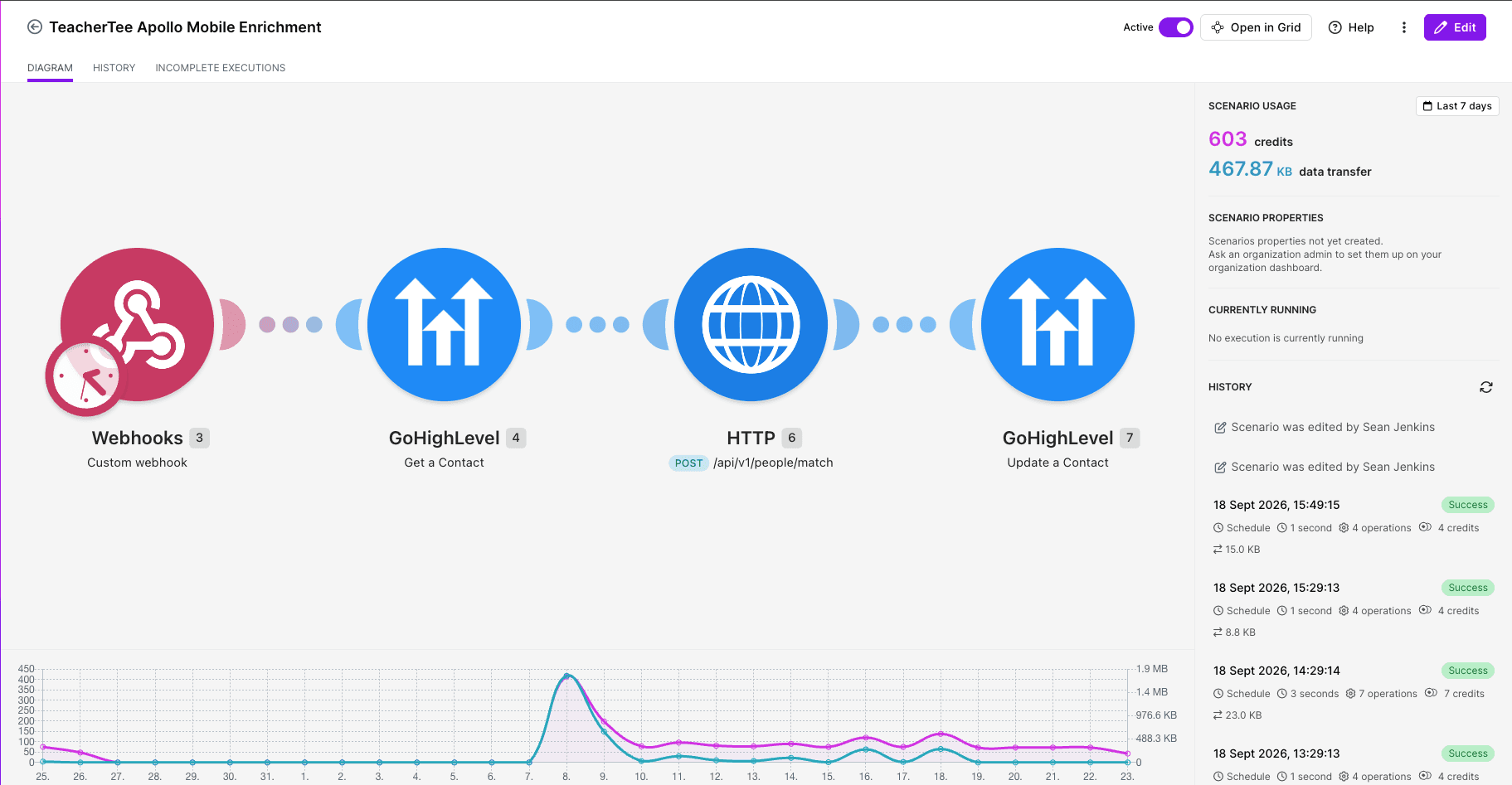
- Make retrieves the engaged CRM record and requests phone data through Apollo
- Success and failure states are mapped back into the operational workflow
- Failed enrichment moves to review rather than uncontrolled paid retries
Stage D
SDR sales operations
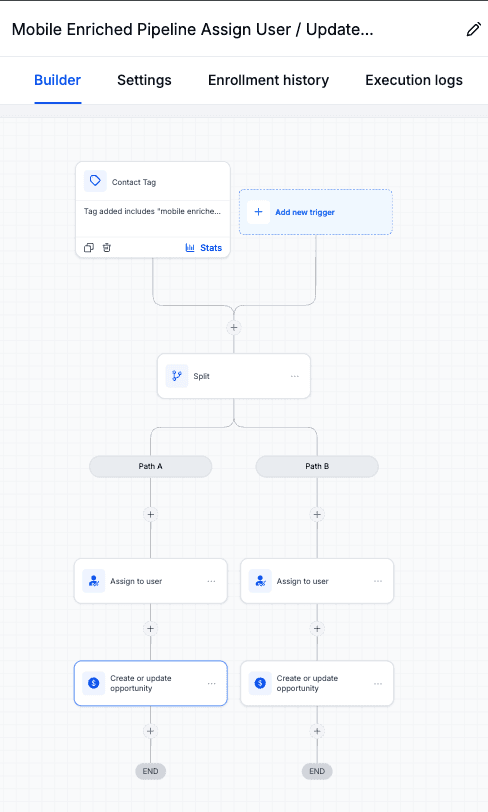
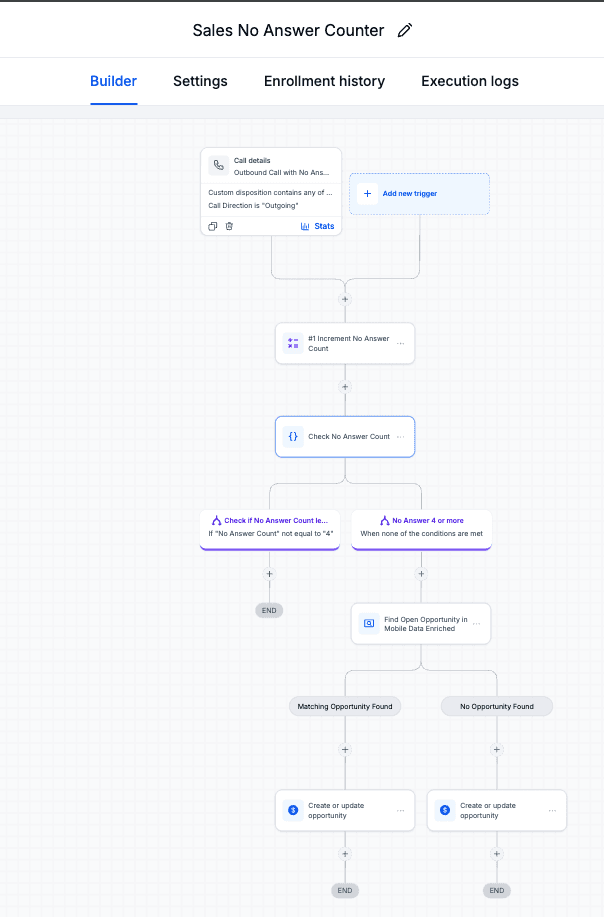
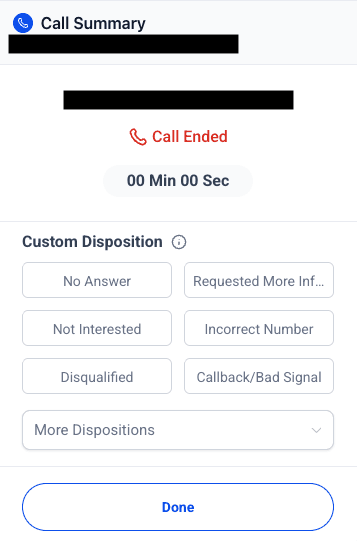
Once a mobile number is available, Leadconnector (GoHighLevel) assigns the contact and moves the opportunity into the callable pipeline. The SDR records the outcome once through a custom disposition.
Why it matters
Routine pipeline administration responds to the salesperson's decision, letting the SDR concentrate on calls and genuine follow-up.
- Mobile-enriched contacts are assigned automatically
- Custom dispositions trigger the correct downstream CRM action
- No Answer attempts are counted automatically
- After four unsuccessful attempts, exhausted records leave the primary calling process
Stage E
AI call documentation
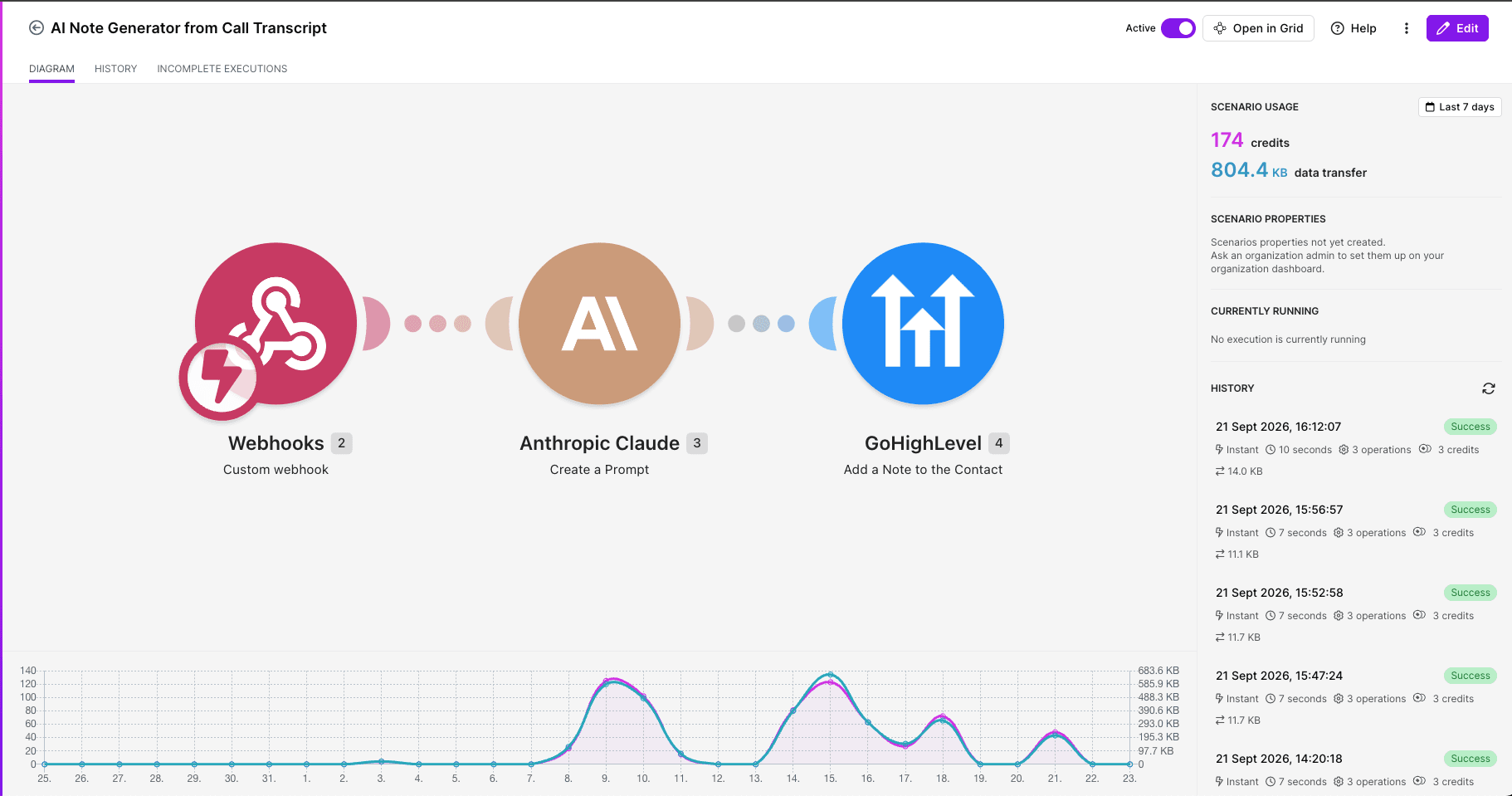
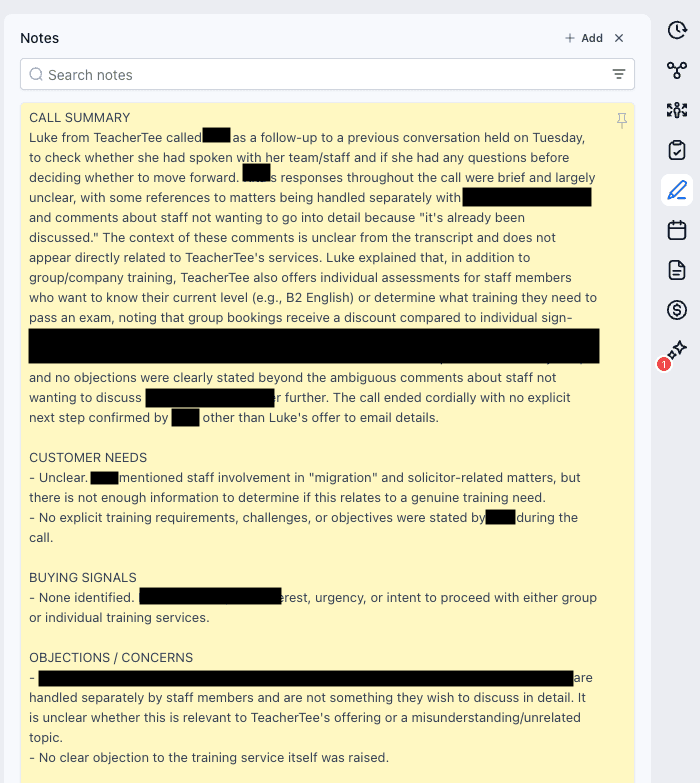
For qualifying calls, the Leadconnector (GoHighLevel) transcript is sent by webhook through Make.com to Claude, which produces a structured note and writes it back to the contact record.
Why it matters
The workflow removes repetitive documentation while keeping the SDR responsible for the sales conversation, judgment and follow-up.
- Structured sections improve consistency across CRM notes
- The prompt is restricted to information present in the transcript
- Uncertain, incomplete or poor calls are explicitly flagged
- The workflow does not invent next steps, objections or buying intent
Implementation evolution
The same system gained new operational layers over time
The implementation progressed from outbound foundation to sales-operations reliability and finally structured AI documentation.
Mid-July 2026
Outbound foundation
- Prospect data and Airtable source layer
- Primary enrichment and CRM synchronisation
- Email marketing through to mobile-enriched leads
Live iteration
Sales operations + reliability
- Custom dispositions and automated pipeline movement
- No Answer counter and exhausted-record filtering
- Duplicate-contact handling and stronger Airtable/Leadconnector (GoHighLevel) synchronisation
First week of September 2026
AI documentation
- Qualifying call transcript and webhook
- Make.com orchestration and Claude processing
- Structured note written back to Leadconnector (GoHighLevel)
Key design decisions
Architecture shaped by cost, traceability and real user behaviour
The strongest choices were not about adding more automation. They were about deciding when automation should run, where exceptions should stop, and how people should interact with the system.
01
Engagement-led paid enrichment
Mobile enrichment begins only after a contact has a usable email and opens or clicks a campaign email. This focuses Apollo credit spend on contacts showing some evidence of engagement; it does not claim that engagement predicts phone availability.
02
Human review for exceptions
Failed enrichment routes into holding and manual-review processes rather than triggering uncontrolled repeated paid processing.
03
Persistent cross-system identifiers
Leadconnector (GoHighLevel) Contact IDs, sync status and sync dates are written back into Airtable to improve traceability and reduce reprocessing problems.
04
The SDR records the outcome once
Custom dispositions capture the salesperson's call outcome while workflows handle the routine downstream CRM actions.
Results
Production evidence across enrichment, campaign activity and live sales operations
The figures below come from live system and activity reporting. Where tracking or period limitations apply, they are stated directly.
1,904
Leads processed
Roughly two months
1,225
Usable work emails
658
Successful mobile numbers
84.8%
Successful phone reveal rate
658 of 776 attempts
679
No usable work email / failed email enrichment
776
Apollo phone-reveal attempts
118
Unsuccessful mobile-enrichment attempts
Email campaign
Delivery and platform-reported engagement
8,200
Delivered
97.99%
Delivery rate
3,690
Platform-reported opens
45%
Platform-reported open rate
1,155
Platform-reported clicks
14.09%
Platform-reported click rate
- 7 soft bounces
- 163 hard bounces
- 2 unsubscribes
- 0 spam reports
- Hard-bounce events handled automatically
Sales activity
1–23 September 2026
779
Total calls
740
Outbound calls
39
Incoming calls
223
Calls over 30 seconds
TeacherTee's internal qualifying threshold
Commercial activity
Commercial activity generated
19
Discovery meetings booked
≈10
Proposals sent
Reporting context
Call activity covers 1–23 September 2026. All but two recorded discovery meetings and proposals occurred from 8 September onwards. Production, campaign, calling and commercial reporting periods differ, so these figures should not be read as one perfectly sequential funnel cohort. Email opens and clicks are platform-reported and subject to normal tracking limitations. No closed revenue is attributed to this case study.
Operational impact
From preparation-heavy prospecting to a call-focused operating model
The implementation changed where the SDR spent time and moved routine administration into defined workflows.
Before
Preparation and administration came first
- 10–15 minutes estimated preparation per lead
- Manual research and enrichment
- Manual CRM entry and pipeline movement
- Manual tracking of repeated No Answers
- Manual CRM note-taking
After
The SDR primarily focuses on calls and genuine follow-up
- Lead research and preparation largely automated
- Enrichment, CRM routing and SDR assignment automated
- Engagement controls where paid enrichment is used
- Dispositions handle routine pipeline actions
- Four-No-Answer logic filters exhausted records
- Qualifying calls create structured AI-assisted notes
- The SDR focuses primarily on calls and genuine follow-up
Cost-aware implementation
Commercial constraints shaped the system
Make.com
≈£8/month
Implementation period
≈£24 across the implementation period
Apollo
≈$150
Cost constraints directly shaped the architecture: enrichment was batched, paid mobile reveals were engagement-led, and failures were routed for review rather than repeatedly consuming credits.
Technical challenges solved
Reliability depended on managing state across systems
The difficult work sat between tools: preserving identifiers, mapping asynchronous results, handling exceptions and improving the live workflow without breaking the operating process.
Challenge 01
Primary email-enrichment workflow
The most technically demanding part moved data from Airtable through Apollo and back into Airtable and Leadconnector (GoHighLevel) while maintaining state across multiple systems.
- Conditional success and failure routes
- Duplicate-contact error handling
- Cross-system identifiers, dates and sync status
Challenge 02
Apollo mobile enrichment
Mapping mobile-data-enriched true/false states across automations and handling asynchronous enrichment results required deliberate troubleshooting.
- Webhook-triggered processing
- Asynchronous result handling
- Reliable success and failure mapping
Challenge 03
Live SDR workflow improvements
Pipeline movement began as a manual process. Feedback from real calls led to a tighter operating layer built around how the SDR actually worked.
- Custom call dispositions
- Automatic pipeline movement
- No Answer counting and filtering after four attempts
AI call notes
Applied AI inside a controlled operational workflow
This is applied AI inside a defined operational workflow. Claude transforms a qualifying call transcript into a consistent CRM note; it does not conduct the call or make autonomous sales decisions.
Production flow
- Leadconnector (GoHighLevel) transcript
- Webhook
- Make.com
- Claude
- Structured CRM note
- Leadconnector (GoHighLevel)
Structured output
- Call Summary
- Customer Needs
- Buying Signals
- Objections / Concerns
- Next Steps
- Important Details
Guardrails
- Use transcript information only
- Do not invent next steps or objections
- Do not exaggerate buying intent
- State uncertainty
- Flag incomplete or poor calls
Human responsibility remains
The SDR remains responsible for the sales conversation, commercial judgment and genuine follow-up.
Client perspective
“From day one, he took ownership of building the operational backbone of TeacherTee and completely transformed how the business runs behind the scenes. He designed and implemented our operations, automations and internal systems from the ground up, turning what was once a collection of manual processes into a streamlined, scalable machine. Thanks to Sean, our workflows are faster, more reliable and significantly more efficient, allowing the team to focus on growth rather than administration.”
What this project demonstrates
Commercial systems work grounded in operational reality
Alectis starts by understanding the operating problem, then designs and implements the system around how the team actually works.
01
CRM architecture
02
Workflow automation
03
Multi-system integration
04
API and webhook implementation
05
Sales operations
06
Data synchronisation
07
Error handling
08
Applied AI
09
User-driven iteration
10
Cost-aware implementation
Start with the operating problem
Have a sales or operations process that still depends on repetitive manual work?
Alectis designs and implements CRM, automation and AI systems around the way businesses actually operate.