
Case study
AI-Powered Sales Operations Workflow
An end-to-end sales operations workflow that captures inbound leads, automates AI qualification, priority routing, CRM record creation, pipeline visibility, and stakeholder notifications so high-priority opportunities can be identified and acted on faster.
Video Walkthrough Coming Soon
A full walkthrough for this case study is currently being finalised and will be published shortly.
The complete architecture, implementation details, screenshots, outcomes, and technical documentation remain available throughout this case study.
1
End-to-end automation workflow
Supported
5
Integrated platforms
Supported
20+
CRM fields automated
Supported
3
AI qualification routes
Supported
Business context
Why the project mattered
Lead qualification matters because inbound enquiries need to be assessed consistently before sales teams can decide where to focus attention.
Manual lead processing creates operational drag through repeated review, inconsistent qualification, delayed follow-up, and duplicated administration.
Startups and small businesses often need clearer lead visibility and prioritisation without the complexity of enterprise CRM platforms.
This project focused on building a lightweight sales operations workflow that improves intake, AI analysis, CRM creation, pipeline assignment, and stakeholder notification.
Problem statement
What had to improve
Design and implement a lightweight operational system that captures inbound leads, analyses lead quality using AI, routes opportunities by priority, updates CRM records, manages pipeline visibility, and notifies stakeholders of high-priority opportunities.
Manual lead review
Inbound lead details required repeated human review before qualification, routing, and follow-up decisions could be made.
Inconsistent qualification
Qualification and prioritisation could vary when criteria were not standardised inside a defined operating workflow.
Delayed follow-up
High-priority opportunities needed faster identification and stakeholder notification to support timely action.
Limited operational visibility
Lead progression, pipeline stage, AI scoring, and follow-up context needed to be visible in a lightweight CRM view.
Repetitive administration
CRM creation, field updates, scoring outputs, and stakeholder summaries created avoidable manual work.
Lack of standardised routing
The process needed repeatable high, medium, and low priority routing logic based on AI qualification outputs.
Discovery & analysis
How the workflow was understood
Before the solution was framed, the work focused on understanding the operating conditions around the problem.
- Requirements gathering clarified the lead data, stakeholder needs, CRM fields, routing scenarios, and notification requirements.
- Business process analysis showed that lead intake, qualification, prioritisation, CRM creation, pipeline assignment, and follow-up needed to operate as one workflow.
- Workflow design focused on moving lead information from form submission to AI analysis, routing logic, CRM creation, and stakeholder action.
- Qualification criteria were developed to support AI lead scoring, priority classification, sales insights, and recommended next steps.
- Routing logic was planned around three AI qualification routes: high priority, medium priority, and low priority.
- Stakeholder requirements included faster visibility of high-value opportunities, clearer CRM records, and more consistent qualification outputs.
Analysis method
The work translated process observations into requirements, workflow decisions, implementation constraints, and review points.
Solution overview
What was built and why
The completed workflow captures inbound lead information through Tally, including contact details, company information, operational challenges, urgency level, current tools, and business context.
Make.com orchestrates the workflow by receiving form submissions, triggering OpenAI analysis, applying routing logic, creating Airtable CRM records, assigning pipeline stages, and sending Gmail notifications.
OpenAI acts as the qualification engine, generating lead scoring, priority classification, executive summaries, pain points, recommendations, discovery focus, suggested questions, risk notes, next steps, and follow-up drafts.
Airtable acts as the central CRM and sales pipeline, storing lead information, AI qualification outputs, pipeline stages, and follow-up actions.
Gmail notifications alert stakeholders when high-priority leads are identified, supporting faster sales response and follow-up.
Architecture
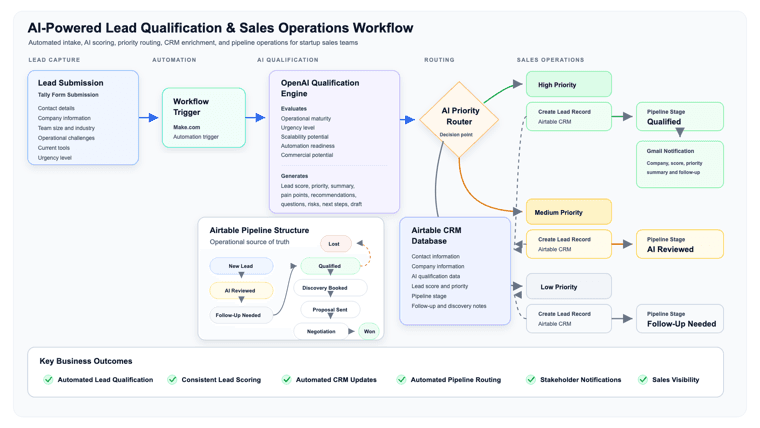
Architecture and workflow diagram
The diagram area is designed to make the operating model visible: inputs, workflow stages, decision points, handoffs, and review loops.
Implementation
Implementation Journey
Tools used
Jira, Make.com, Airtable, OpenAI, Tally, Gmail
Step 1
Lead Capture Design
Designed the Tally discovery call form to capture contact details, company context, operational challenges, urgency, current tools, and additional business information.
Step 2
AI Qualification Workflow
Built the OpenAI qualification workflow to analyse lead quality, generate scoring, classify priority, and produce sales and operational insights.
Step 3
CRM & Pipeline Design
Designed the Airtable CRM structure, automated more than 20 CRM fields, and configured a nine-stage sales pipeline.
Step 4
Notification Layer
Configured Gmail notifications for high-priority lead alerts so stakeholders can act on qualified opportunities faster.
Step 5
Testing & Validation
Tested the end-to-end workflow using multiple sample leads across industries, company sizes, and urgency levels.
Step 6
Documentation & Portfolio Assets
Created documentation, architecture visuals, implementation evidence, and portfolio-ready assets to communicate the workflow clearly.
Evidence
Evidence gallery
This section supports product screenshots, workflow screenshots, CRM views, Airtable or Make evidence, automation screenshots, and UI states.
Workflow architecture diagram
High-level architecture showing lead submission, automation, OpenAI qualification, routing, CRM creation, pipeline assignment, and notification.
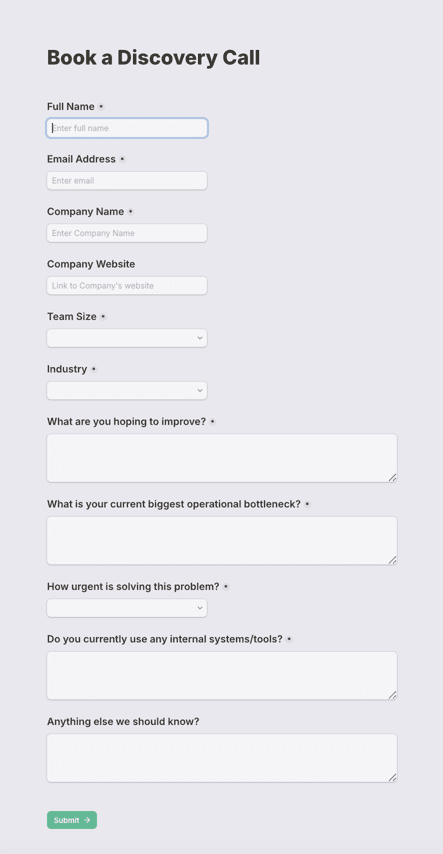
Tally lead capture form
Lead capture form collecting contact details, company information, operational challenges, urgency level, current tools, and business context.
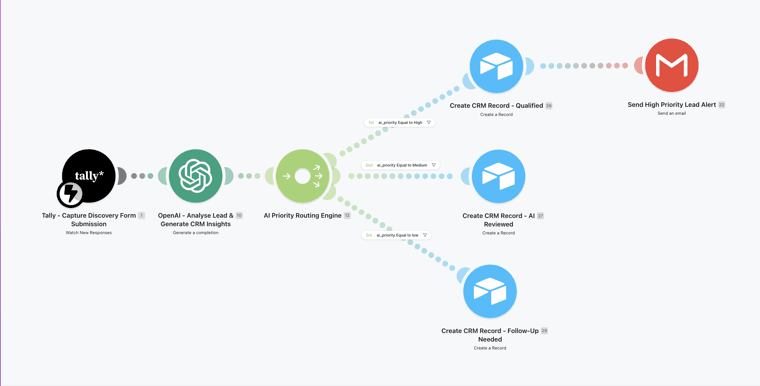
Make.com automation workflow
Automation workflow orchestrating form submission, OpenAI analysis, priority routing, Airtable CRM creation, and Gmail notification.

Airtable CRM and pipeline
Airtable CRM and sales pipeline showing lead records, AI qualification fields, and pipeline stages.

Airtable pipeline stages
Pipeline view covering New Lead, AI Reviewed, Follow-Up Needed, Qualified, Discovery Booked, Proposal Sent, Negotiation, Won, and Lost.
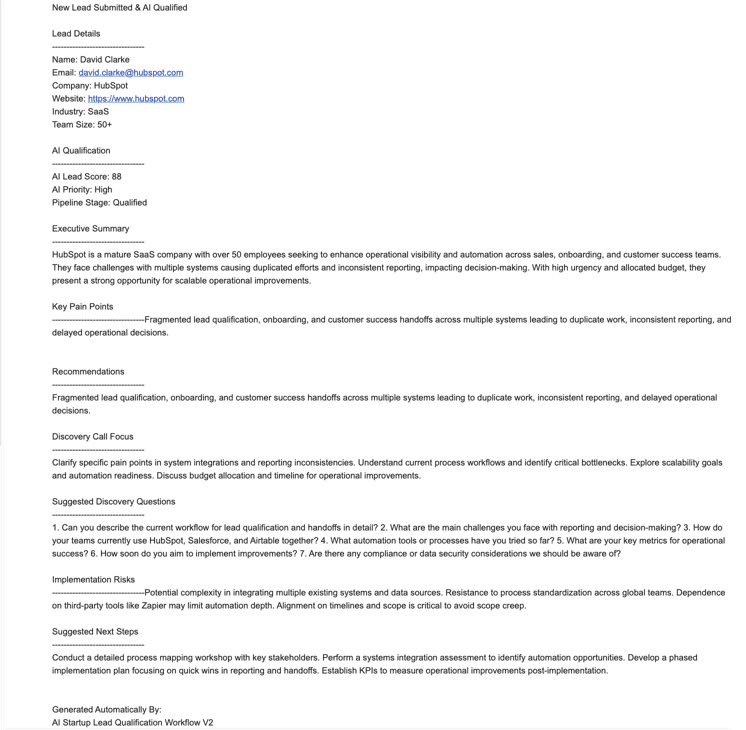
Gmail notification example
Stakeholder notification generated for a high-priority lead, including AI score, priority, executive summary, pain points, recommendations, and next steps.
Outcomes
Outcomes and impact
Outcomes are presented as supported operational improvements. Quantitative metrics remain marked as TBC where production data is not yet available.
Before
- Lead review depended on manual interpretation.
- Qualification and routing were less standardised.
- Follow-up could be delayed while leads were manually assessed.
- Pipeline visibility and AI-driven sales context were not available in a single lightweight CRM workflow.
After
- Automated lead qualification and prioritisation.
- Consistent AI-driven lead scoring methodology.
- Automated CRM record creation.
- Automated pipeline assignment.
- Faster identification of high-priority opportunities.
- Improved stakeholder visibility through automated notifications.
- Standardised qualification and follow-up process.
Metrics
1
End-to-end automation workflow
Supported
5
Integrated platforms
Supported
20+
CRM fields automated
Supported
3
AI qualification routes
Supported
9
Pipeline stages
Supported
10
Automated CRM outputs
Supported
100%
Automated lead routing
Supported
Outcomes
The project delivered a fully functioning AI-powered lead qualification and sales operations workflow.
The solution provides a strong foundation for future enhancements including analytics dashboards, onboarding workflows, AI-generated outreach, CRM enrichment, and proposal generation.
No ROI figures or time savings are included because they were not documented in the source material.
Have a similar workflow that needs clearer structure?
Book a discovery callTesting
Testing and validation dashboard
Testing confirmed reliable workflow execution across the primary business scenarios documented for the project.
Passed
Lead Capture
Passed
AI Qualification
Passed
AI Lead Scoring
Passed
High Priority Routing
Passed
Medium Priority Routing
Passed
Low Priority Routing
Passed
Airtable Record Creation
Passed
Pipeline Stage Assignment
Passed
Gmail Notification Delivery
Passed
End-to-End Workflow Execution
Lessons
Lessons learned
Prompt quality impacts output quality.
AI prompt design significantly impacts output quality and classification consistency.
CRM architecture should be designed first.
CRM structure should be designed before workflow automation begins because field naming and mapping are critical to workflow stability.
Router logic requires extensive testing.
Reliable lead routing depends on testing high, medium, and low priority paths and identifying edge cases.
Documentation is critical.
Documentation is as important as implementation when communicating project value to stakeholders.
Business process understanding matters most.
Business process understanding is often more important than technical complexity when designing operational workflows.
Iterative refinement improves automation quality.
Automation projects benefit from iterative refinement rather than attempting to build the final solution immediately.
Future
Future enhancements
The documented roadmap identifies practical ways the workflow could be extended without overstating current impact.
AI-generated discovery call agendas
CRM enrichment using external data sources
Automated follow-up sequence generation
Sales dashboard and reporting layer
Proposal generation automation
Lead ownership assignment workflows
Integration with HubSpot or Salesforce
More work
Explore more work
AI SALES OPERATIONS
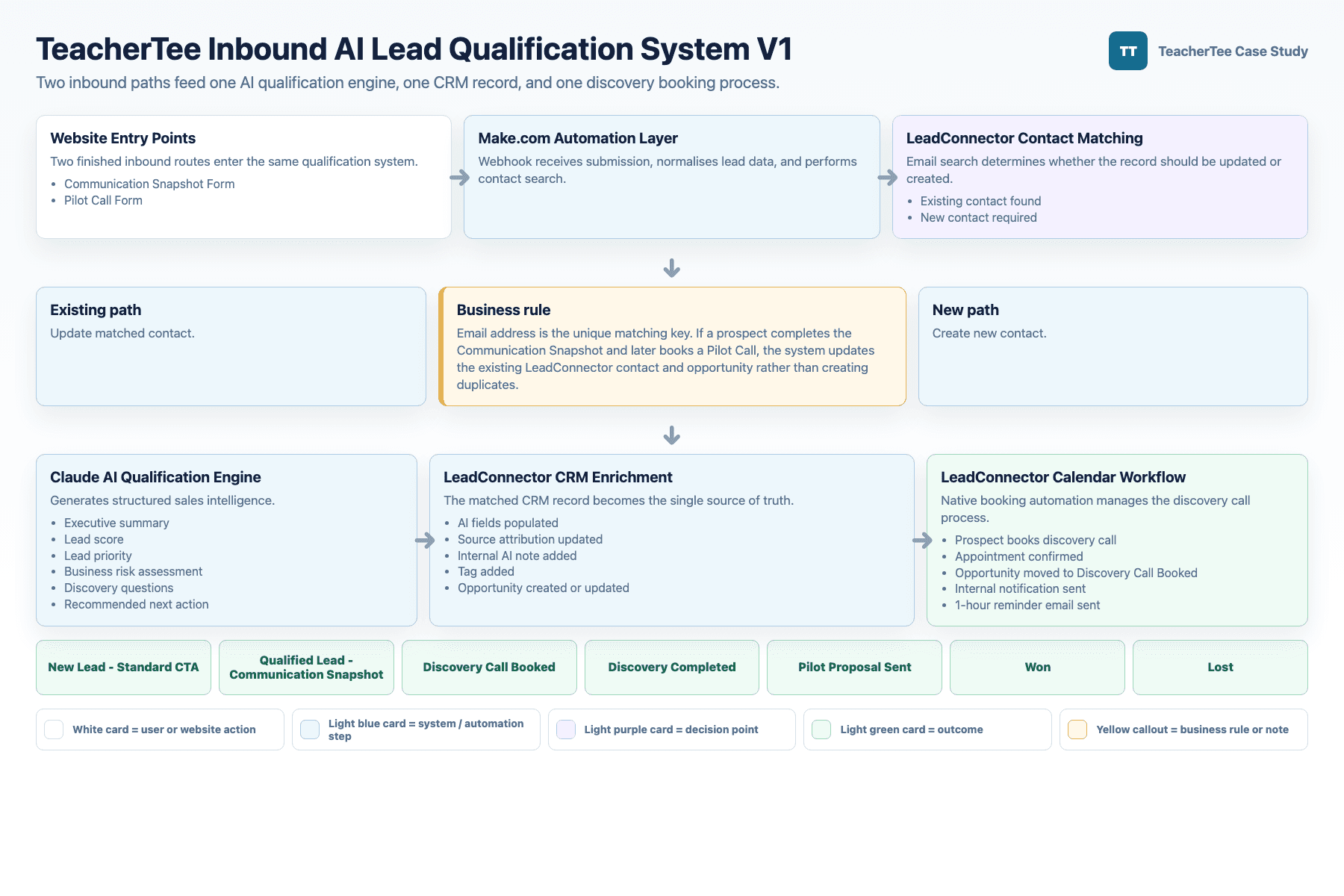
TeacherTee AI Lead System
An AI-powered inbound qualification workflow built with Make.com, LeadConnector, and Claude to enrich lead context, prioritise enquiries, and support better sales conversations.
View case study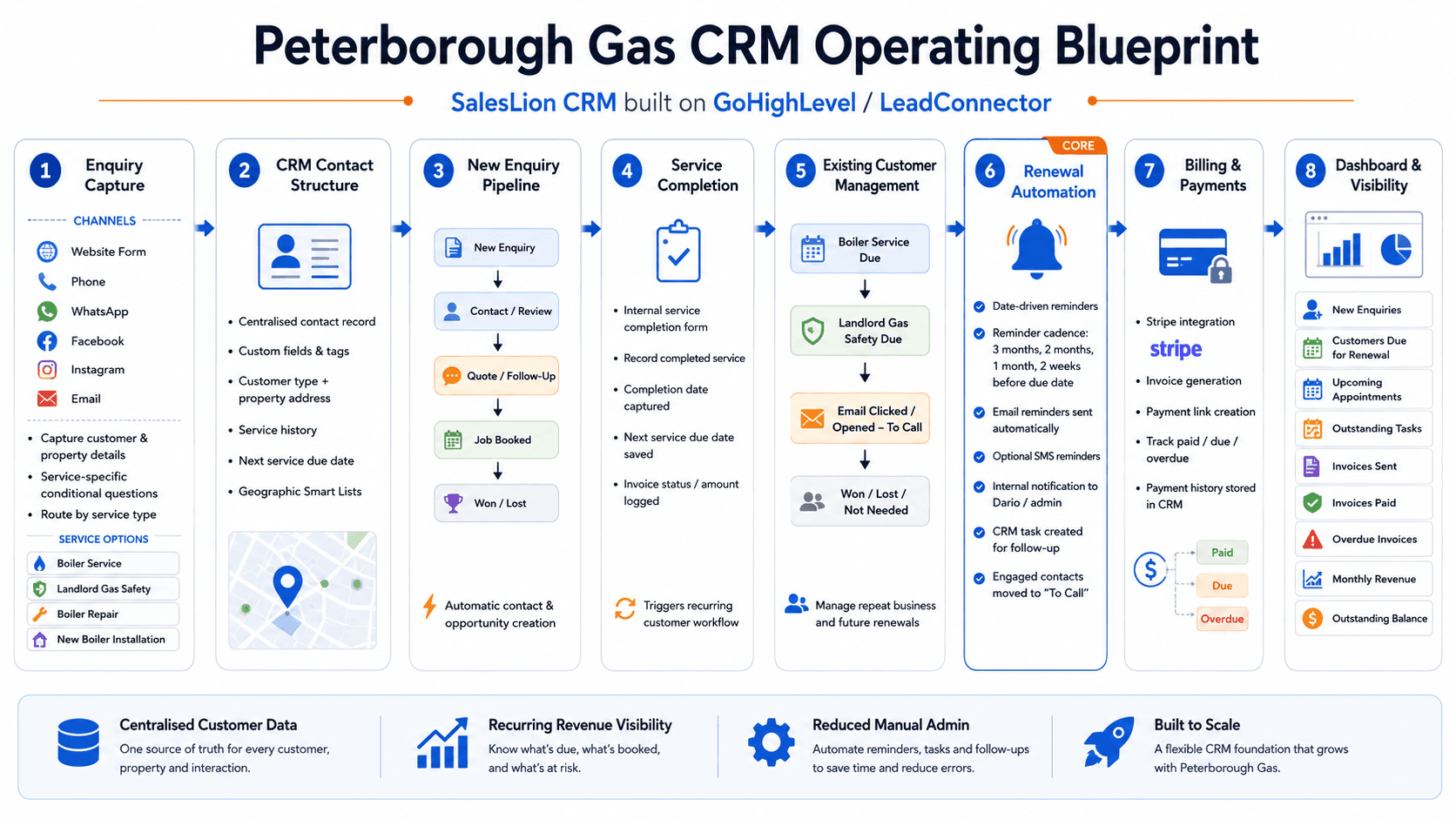
CRM Operations
Peterborough Gas CRM Operating System
A complete SalesLion CRM operating structure built on GoHighLevel and LeadConnector to manage enquiries, customer records, recurring services, renewal follow-up, billing and operational visibility.
View case studyTeacherTee Outbound Sales System
Case study preview pending
Sales operations
TeacherTee Outbound Sales System
Designed and implemented a complete outbound sales operating system to support business development, prospect management, and scalable client acquisition.
View case study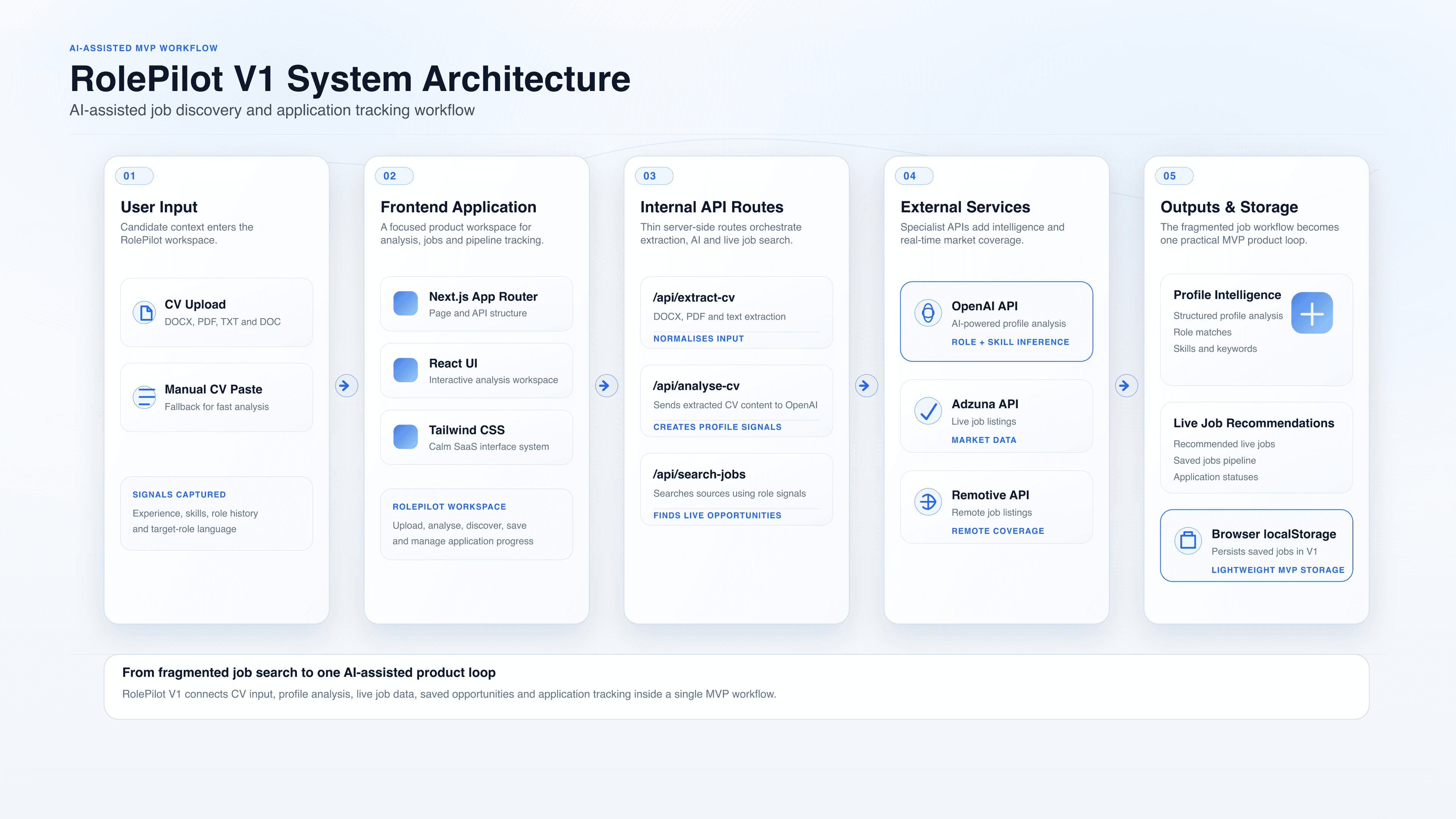
Product system
RolePilot V1
RolePilot is an AI-powered job matching and application tracking platform designed to reduce the friction involved in modern job searching.
View case studyLet’s Talk About Your Operations.
If this project resembles a process inside your business, a discovery call can explore AI operations, workflow automation, CRM design, sales operations improvement, or process optimisation.